The text from my daughter’s phone lit up my screen in the middle of a perfectly ordinary afternoon, and in a moment, the world shifted. When news broke of an active shooter at Brown University, families across the globe held their breath.
I had been doing something quite ordinary: running errands with my youngest daughter, who wanted to stop by the thrift store. I was grateful to be out after shoulder surgery and to have been cleared to drive for about a week. Each outing felt tentative and tiring—small victories in healing, a return to normal life.
Our trip was unexpectedly successful; my daughter found a red-and-white holiday sweater to wear while skiing. I found a limited-edition lithograph by Japanese artist Hisashi Otsuka, titled Eyes of Otsuka—butterflies moving upward along one side of a person’s face, representing transformation and the duality between reality and dreams. With a coupon from a donation, the final price came to $4.80. I felt lucky and fortunate.
Seconds later, at 4:16 p.m., my phone vibrated. I read a text from my daughter, a Brown University student, wrapping up finals week: Hi. I am safe. There’s an active shooter on campus. I had to leave because someone with a gun entered a classroom…allegedly.
Her sisters and I cycled through shock, disbelief, and frantic information sharing. Her twin sister demanded a selfie, proof she was ok. She forwarded official BrownUAlert messages and updated us on her safety.
Urgent: There’s an active shooter near Barus and Holley Engineering. Lock doors, silence phones, and stay hidden until further notice. Remember: RUN if you are in the affected location and can evacuate safely. HIDE if evacuation is not possible. FIGHT as a last resort. Stay tuned for further safety information.
This was not allegedly….there was an active shooter in the building on campus.
Those words—active shooter—are words we hear far too often now, usually at a distance, folded into headlines or news alerts that allow us to exhale with relief because this time it isn’t us.
Until it is.
Until the distance collapses and the words land inside your mind and body, changing everything in your life.
Time slowed in a way I didn’t know was possible. Waiting to hear from her, waiting to know she was safe, while my heart rehearsed futures I didn’t want to imagine.
As a parent, you spend years teaching your children to become independent, capable, brave, and curious. You celebrate when they move confidently into the world. But in moments like this, all the pride collapses into one primal instinct: keep my child alive.
Her sisters responded in disbelief, asking for details and asking if she was okay. They told her they loved her and shared what they were hearing. I sent a text to quiet the noise, knowing, instinctively, that I needed to be a regulated, emotionally calm parent to all of my children, and responded: What can we do for you right now? We love you so much.
She responded: Nothing, thank you. Love you all. We’re waiting for the shooter to be apprehended. She continued sending updates—another BrownUAlert, then another, and another, followed by more —sharing: “I am so upset.”
She shared that she was silencing her phone. The lights were being turned off. She was in the gym, wearing her Brown Design Workshop apron over a tank top, jeans, and Converse sneakers.
She texted: It’s chilly in here. I’m cold.
I texted: I’m sure, you’re in shock.
She responded: I’m going to get on a treadmill… lol
As a psychologist, I recognized the crisis skills she was using, humor and distress tolerance skills, specifically the TIPP skill. Using temperature (T), engaging in intense exercise (I), paced breathing (P), and progressive muscle relaxation (P) to navigate intense fear or anxiety.
As a clinical psychologist who supports people in crisis, the duality of my worlds—mother and psychologist—was overlapping that day. I was in awe of her coping as she practiced the skills woven throughout her life, having been honed through school preparations for lockdowns and school shootings, and having a mother as a psychologist, were now put into practice. She followed up by sending me a text: #skills
She remained calm, distracting herself, continuing to ask for and share information. I told her I was on my way. She told me not to come up—reminding me of the shelter-in-place order — and instead directed me to her off-campus housing. I didn’t respond to or listen to her request. After bringing my youngest home, I headed toward Providence.
As I waited to merge onto the highway, a wave of intense emotion washed over me—fear, anguish, sadness, overwhelm. I let out a guttural scream. Then came tears. I wondered, briefly, if it was safe to drive.
I took deep breaths and grounded myself by calling friends and my parents. I gave updates and told my parents not to call their granddaughter—her phone was silenced; she was sheltering in place, they could text, and I drove on.
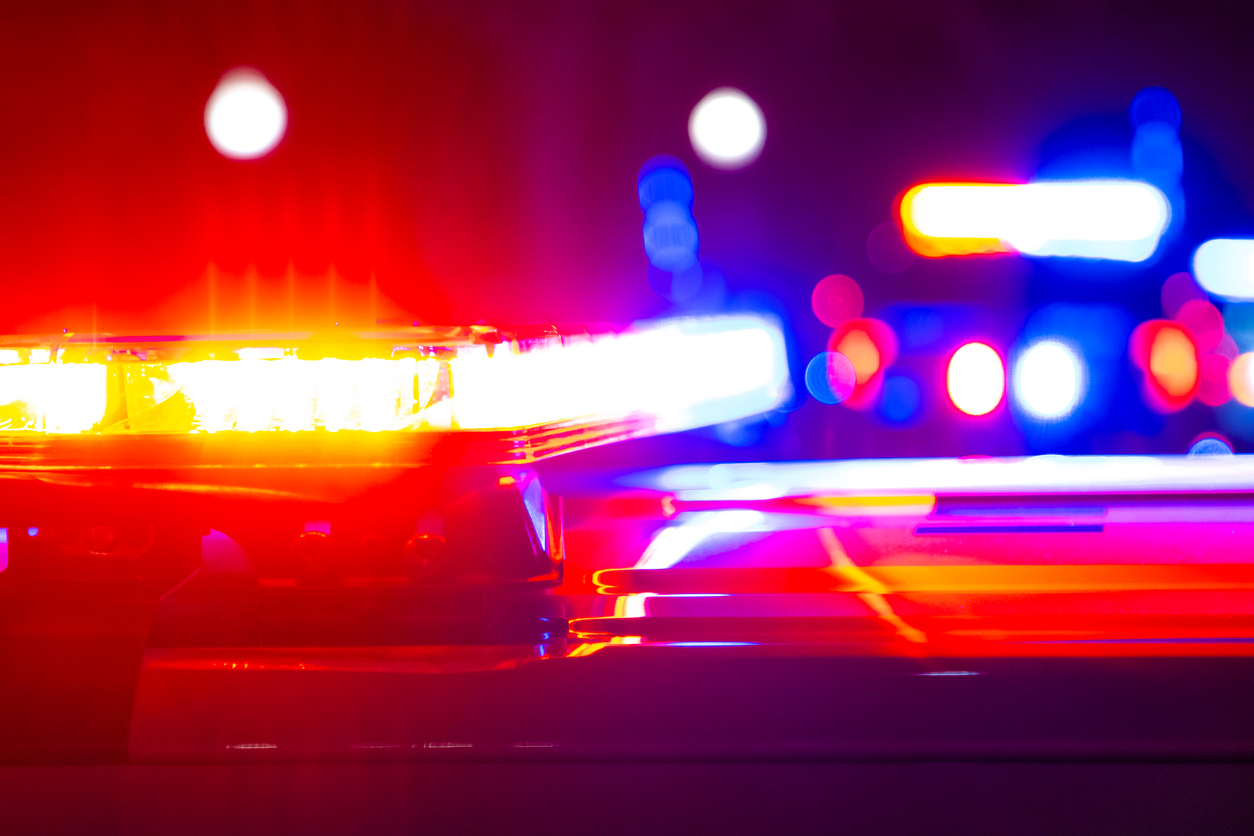
I got as close as I could to the cordoned area and parked my car—streets fenced with caution tape, state and local police, ATF, FBI, cruisers and armored vehicles, red and blue lights flashing everywhere I turned. An FBI agent provided a brief update, cautioned me to be careful, and allowed me to proceed. Thayer Street was eerily quiet. I walked a block or two and approached the police and first responders, who were wearing vests and helmets, carrying rifles, and equipped with night-vision gear. I asked if I could continue. “My daughter is—was in the building.” I was allowed to proceed.
As I approached the Nelson Fitness Center, reporters stopped me and asked, Are you a parent? Are you in communication with your child? Can you tell us what your child texted you? I shook my head in disbelief. I had no words. I just wanted to see my daughter.
A university staff member escorted me inside. A police officer calmly informed me she needed to search me and asked me to raise my arms and to show her my ID. I panicked for a moment, telling her I recently had shoulder surgery and could not fully raise my left arm. She directed me to place my hands on my chest, searched me, and cleared me.
At a table, I gave my name and my daughter’s, repeating the spelling of both. A staff member placed a neon green band on my right wrist. I was directed to the pool area—hot, humid, and stuffy. I was one of the first parents to arrive.
I distracted myself by sending updates to family and friends, taking a photo of my wristband against the pool backdrop, grateful to be closer to her and wondering how long it would be until I could hug her. I prayed and held a religious medallion in my pocket, a gift from my mother the previous Christmas. I began to feel irritated by the humidity in the chlorine-close air, making my hair frizz, and found myself wishing for a hair tie—struck by how trauma is so strange, my mind focused on small, irrelevant details in crisis to cope.
Parents and families continued to arrive, were screened, and given wristbands. We were told students were being evacuated and transferred to an adjacent building, then reunited with families. The timeline was uncertain. Behavioral health staff gathered, offering water bottles and placing tissue boxes on each end of a craft table. I felt an urge to help as a psychologist, and I reminded myself that today, I am a mother, and that was all that mattered.
Police and a SWAT team entered the pool area and informed us they needed to sweep and secure the space. We were moved to another room. As we entered the lobby, I saw a team of first responders and university staff—and then, around the corner, my daughter.
She was one of the first students to emerge.
We hugged and cried. I remember very little else, except the overwhelming gratitude of holding my daughter.
As the evening unfolded, we were offered water, sandwiches, chips, and apples by kind and attentive staff and crisis volunteers. Other parents waited—some for hours—to be reunited with their children. Because my daughter had been relocated on site, there was one small mercy: we could remain together while waiting for clearance to leave. She noted the band on her wrist was neon orange-red, and my wrist had a neon green band, observing we were in an exclusive club….one that no parent or child wants to be part of, and yet so many are.
In the hours that followed, my daughter returned to the moments that stood out to her—fear, grief, uncertainty about how this trauma would shape the remainder of her year and her graduation in the spring. I reminded her she didn’t need answers yet, that healing happens step by step, and that staying connected to loved ones and routines mattered most right now.
I thought about the space she had been in—the design workshop, a place meant for creativity, making, imagining. A space built for innovation, overtaken by fear. Violence does not choose appropriate settings. It interrupts learning, art, and the quiet rhythm of daily life without warning. She expressed uncertainty about how she would return to the building, her personal belongings, her ID, and the espresso drink she treated herself to before working —now suspended in time—how still the scene of ordinary life must appear on campus, abandoned at a moment’s notice.
As the evening passed, we waited together for what felt like a long stretch of time. There was no clear timeline, only intermittent updates and reminders to stay where we were. I gave her my coat to warm up, watched her breathe, watched her settle, eating a portion of a turkey and cheese sandwich with potato chips she placed inside the roll, hugging her every few minutes, grateful to be in her presence.
Eventually, we were allowed to leave. My daughter lives off campus, so we were permitted to head home escorted by a behavioral health staff member past the reporters, through the barricade of police, SWAT, and first responders. No sense of resolution, only direction, walking toward my car parked blocks away, past barricades and flashing lights.
The shooter had not yet been apprehended. We moved quickly, aware that the threat was still unresolved. From there, we drove to pick up her friend, who also lived off campus. Her parents were panicking from continents away. At daybreak in Indonesia, she reassured them that she was safe and on her way to our home.
When we finally arrived home, it was late. The house was quiet. Our cats greeted us at the door, weaving between our legs as if nothing extraordinary had happened. We moved slowly—getting ready for bed, hugging one another, expressing relief, and incredible heaviness in our bodies.
Exhaustion settled in. I loaded the dishwasher, changed the laundry, turned off the lights, and got ready for bed after everyone was settled. I was surprised to sleep at all, recalling the time around 1:45 am.
The next morning, snow covered the ground. I woke early to drive my third daughter to her 7:30 a.m. shift at a grocery store. I was struck—perhaps still in shock—by how life continues in its mundane rhythms after something profound has occurred.
I feel deep gratitude that my daughter is safe, and tremendous grief for her, the victims, the students, families, faculty, and the Brown University community – for the loss of life, the violence, and the uncertainty of what lies ahead. Perhaps this is the enduring duality in which we exist: ordinary days can turn unthinkable with no warning. I wish this were not our reality. For now, I hold both gratitude and sorrow, moving gently through a world that is both beautiful and broken, and in an instant, changed forever.
© Dr. Claire Nicogossian 2025
Dear Claire,
Thank you for sharing this incredible essay! It is beyond heart wrenching to read and share everything you and your entire family went through – it is overwhelming that this is our world! You are truly amazing and I am so grateful that your daughter is okay. Thank you for sharing and for everything you do for so many! Have a great holiday!!